360 Leadership Insights

You give feedback all year. When did you last get any?

You give feedback all year. When did you last get any?

You give feedback all year. When did you last get any?

Structured multi-rater feedback for school leaders, from the people they lead, mapped to the Australian Professional Standard for Principals.

Structured multi-rater feedback for school leaders, from the people they lead, mapped to the Australian Professional Standard for Principals.

Confidential to the leader. ST4S qualified. Data hosted in Australia.

Confidential to the leader. ST4S qualified. Data hosted in Australia.

Book a pilot

Start Your Free Trial

360 leadership insights hero image pivot

The problem

The higher you go, the less you hear

The higher you go, the less you hear

The higher you go, the less you hear

Teachers get feedback from students, coaches and colleagues. Principals get feedback from a review cycle and, if they are lucky, one honest deputy. The gap between how you think you lead and how it lands is invisible by design.

Teachers get feedback from students, coaches and colleagues. Principals get feedback from a review cycle and, if they are lucky, one honest deputy. The gap between how you think you lead and how it lands is invisible by design.

Teachers get feedback from students, coaches and colleagues. Principals get feedback from a review cycle and, if they are lucky, one honest deputy. The gap between how you think you lead and how it lands is invisible by design.

It is also the single biggest lever on teaching quality in your school, and the one you have the least evidence about.

It is also the single biggest lever on teaching quality in your school, and the one you have the least evidence about.

It is also the single biggest lever on teaching quality in your school, and the one you have the least evidence about.

AUSTRALIAN SCHOOL LEADERS SIGNALLING AN INTENTION TO QUIT

AUSTRALIAN SCHOOL LEADERS SIGNALLING AN INTENTION TO QUIT

ALL SCHOOL LEADERS

ALL SCHOOL LEADERS

ALL SCHOOL LEADERS

53.2%

53.2%

53.2%

THOSE WITH LOW JOB SATISFACTION

THOSE WITH LOW JOB SATISFACTION

THOSE WITH LOW JOB SATISFACTION

82.3%

82.3%

82.3%

Intention to quit is not spread evenly. It concentrates among leaders who have lost the sense that the job is working, and job satisfaction is the variable that separates the two groups.

Intention to quit is not spread evenly. It concentrates among leaders who have lost the sense that the job is working, and job satisfaction is the variable that separates the two groups.

Intention to quit is not spread evenly. It concentrates among leaders who have lost the sense that the job is working, and job satisfaction is the variable that separates the two groups.

A leader who cannot see how their leadership is landing has nothing to work with when it stops working. That is the gap this tool closes, and it is why schools use it before a review cycle rather than after one.

A leader who cannot see how their leadership is landing has nothing to work with when it stops working. That is the gap this tool closes, and it is why schools use it before a review cycle rather than after one.

A leader who cannot see how their leadership is landing has nothing to work with when it stops working. That is the gap this tool closes, and it is why schools use it before a review cycle rather than after one.

How it works

Three groups answer. You see the difference.

Three groups answer. You see the difference.

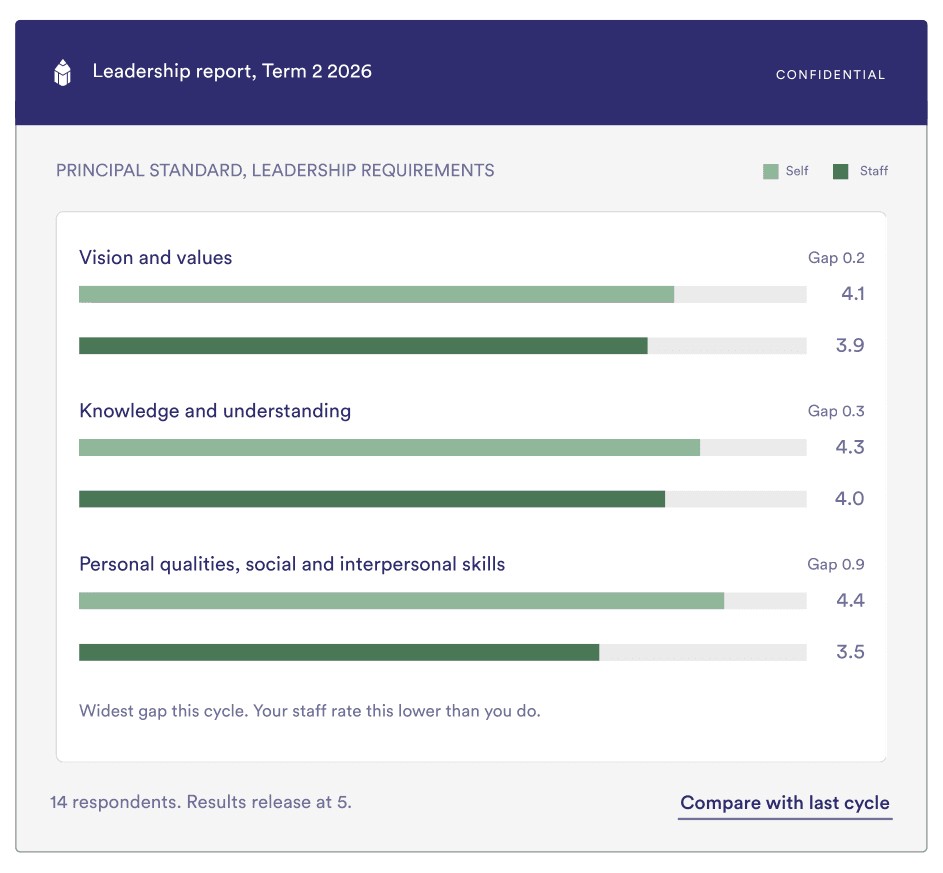
Your leadership team, your teaching staff and your peers respond to a structured tool. Results come back as a comparison between your self-rating and theirs, so the useful information is the gap rather than the score.

Your leadership team, your teaching staff and your peers respond to a structured tool. Results come back as a comparison between your self-rating and theirs, so the useful information is the gap rather than the score.

01

Respondent groups

Your leadership team, teaching staff and peers. You nominate who is in each group, and the groups are reported separately so you can see where the views diverge.

02

The Principal Standard

Items sit against the leadership requirements of the Australian Professional Standard for Principals: vision and values, knowledge and understanding, and personal qualities with social and interpersonal skills.

03

Confidential to the leader

The report belongs to the person it is about. They decide who else reads it, including whether their line manager does.

04

Tracked over time

The same tool each cycle, so the question stops being how you scored and becomes whether the gap is closing.

Why leadership completes the picture

Three levels of the same question

Three levels of the same question

Three levels of the same question

Teaching and Learning tells you how practice lands with students. Wellbeing tells you whether students are ready to learn. Leadership tells you whether the conditions you are setting are producing either.

Teaching and Learning tells you how practice lands with students. Wellbeing tells you whether students are ready to learn. Leadership tells you whether the conditions you are setting are producing either.

One evidence base, asking at three levels: what is actually shaping learning here?

One evidence base, asking at three levels: what is actually shaping learning here?

One evidence base, asking at three levels: what is actually shaping learning here?

STUDENTS

How teaching practice lands, classroom by classroom.

How teaching practice lands, classroom by classroom.

How teaching practice lands, classroom by classroom.

CONDITIONS

Whether students are ready to learn before the lesson starts.

Whether students are ready to learn before the lesson starts.

Whether students are ready to learn before the lesson starts.

LEADERSHIP

LEADERSHIP

Whether the conditions you set are producing either of the above.

Whether the conditions you set are producing either of the above.

Whether the conditions you set are producing either of the above.

You are here

You are here

You are here

Proof and use cases

Where schools and systems put it to work

Where schools and systems put it to work

Where schools and systems put it to work

Performance and development

The leader brings their own evidence to their performance and development conversation, rather than the conversation relying on impressions.

Leadership team development

Every member of the team runs the same tool, so the team can talk about its collective pattern without anyone having to expose their individual report.

Succession planning

Aspiring leaders get a read on how they are already landing with colleagues, well before they apply for the role.

System-level leadership programs

Dioceses and networks run it as the measurement layer inside an existing leadership program, with cohort-level reporting to the program and individual reports staying with each leader.

Confidentiality and safety

Who sees what, and why staff answer honestly

Who sees what, and why staff answer honestly

A 360 is only as good as the candour of the people answering it. These are the rules that make candour rational, and they are the same for every school.

A 360 is only as good as the candour of the people answering it. These are the rules that make candour rational, and they are the same for every school.

Who owns the report

Who owns the report

Who owns the report

The leader it is about. Nobody else receives it by default, including the principal, the board and the system. The leader chooses who to share it with.

The leader it is about. Nobody else receives it by default, including the principal, the board and the system. The leader chooses who to share it with.

Respondent threshold

Respondent threshold

Respondent threshold

Results release at five respondents per group. Below five, that group is not reported at all. No partial view, no averages of two people, no way to reverse-engineer an individual answer.

Results release at five respondents per group. Below five, that group is not reported at all. No partial view, no averages of two people, no way to reverse-engineer an individual answer.

Small leadership teams

Small leadership teams

Small leadership teams

Groups are combined rather than exposed. Where a team is too small to report separately, its responses are merged into a wider group so the pattern is still visible and the individuals are not.

Groups are combined rather than exposed. Where a team is too small to report separately, its responses are merged into a wider group so the pattern is still visible and the individuals are not.

Free text

Free text

Free text

Comments are returned to the leader unedited and unattributed. Respondents are told this before they write, so there is no ambiguity about what they are agreeing to.

Comments are returned to the leader unedited and unattributed. Respondents are told this before they write, so there is no ambiguity about what they are agreeing to.

Comments are returned to the leader unedited and unattributed. Respondents are told this before they write, so there is no ambiguity about what they are agreeing to.

Find out how your leadership
is landing

Find out how your leadership
is landing